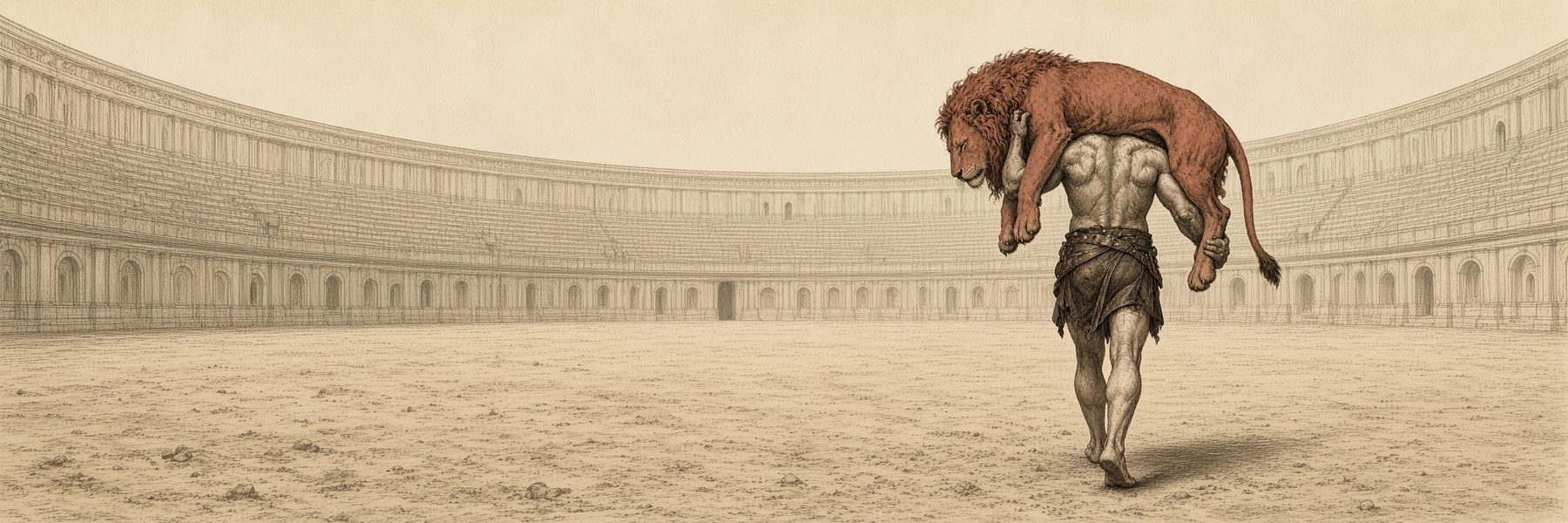
A man walks out of an empty arena carrying a lion across his shoulders; pen and ink on cream paper, the lion in rust.

An author-owned imprintThe Asking Press

Robert T. O’Leary, D.O.

Books and papers on what the body has left to spend.

We used to wear out from too much work.Now we wear down from too much help.No one ever asks for less help.

Reserve is the distance between what you can do and the fixed tasks of an independent life. Help that does what you could still do spends it.

The books

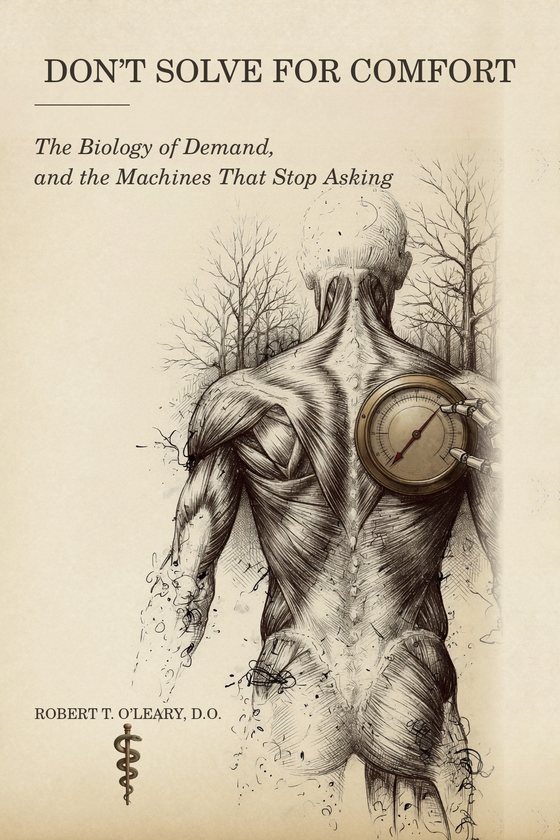
Cover of Don't Solve for Comfort: a pen-and-ink figure seen from behind, with a pressure gauge set into the back.

Don’t Solve for Comfort

The Biology of Demand, and the Machines That Stop Asking
Nonfiction · Manuscript complete

The science book, for readers who want the biology of demand.

What happens to us when our surroundings stop asking things of us?

Comfort is a design goal that, met completely, removes the demand the body was built to answer.

The argument underneath all of it. Demand is the input the body is regulated against; take it away and capacity falls on a delay long enough to escape notice. For most of human history the load was compulsory. Now the machines are the first force that sets it on purpose, and they are being built to ask less. A clinical book about what we are choosing when we choose ease.

Full manuscript available on request.
Read an excerpt

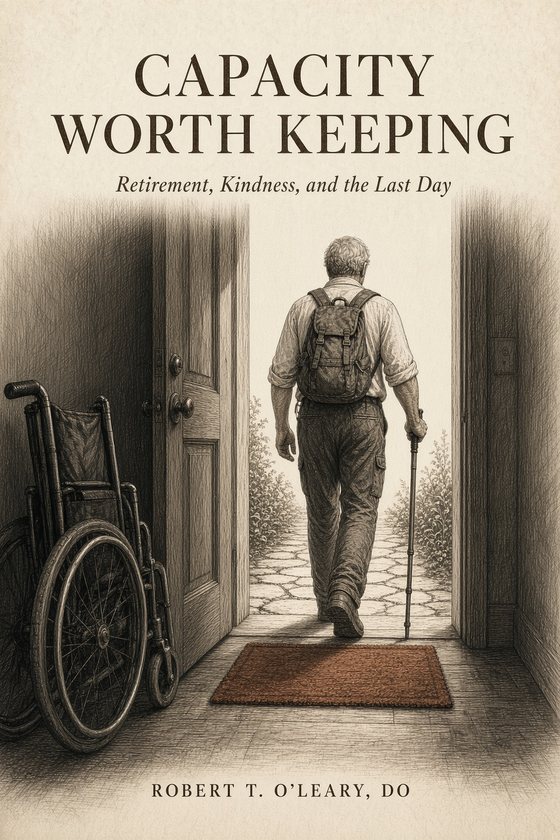
Cover of Capacity Worth Keeping: seen from inside a dim hallway, a man with a daypack and trekking pole walks out the open front door into daylight; a folded wheelchair waits by the wall; pen and ink, the doormat in rust.

Capacity Worth Keeping

Retirement, Kindness, and the Last Day
Nonfiction
Manuscript complete

The retirement book, for the year work stops and the people you retire with.

When the job stops asking, what will?

Nobody told you that the job was the exercise.

For thirty or forty years your day charged you for everything — the stairs, the standing, the carrying, the deadline you could not put down. None of it was recorded anywhere, none of it felt like training, and all of it was holding you up. Then it stopped, on a Friday, and they gave you a cake.

What follows is not old age arriving on schedule. It is a withdrawal, and it is invisible for the same reason the deposits were: nothing was ever counting. The help arrives to meet it, and the help is real — the grab bar, the delivery, the daughter who flies in and empties the sink. Kindness is not the opposite of this problem. Kindness is how it happens.

A physiatrist of thirty-two years, writing about the patients who argued back, makes the case for deciding in advance which load is worth keeping — while it is still your decision to make.

Read an excerpt

Cover of Saphenous: a bare lower leg in a fitted brace, the nerve traced in a thin rust line.

Saphenous

Fiction · Novella
Complete

A nerve that can only listen.

The saphenous nerve runs down the inside of the shin and carries feeling in; it cannot move a muscle. Roman, a physiatrist, runs a neural link into his own saphenous and spends three years learning to read it. His colleague Rex takes the motor link, the one that acts for you, for the opposite reason, and is hollowed out by it. Naomi, disabled from birth, makes the strongest case against Roman’s whole idea, and wins it.

What is spent, endures.

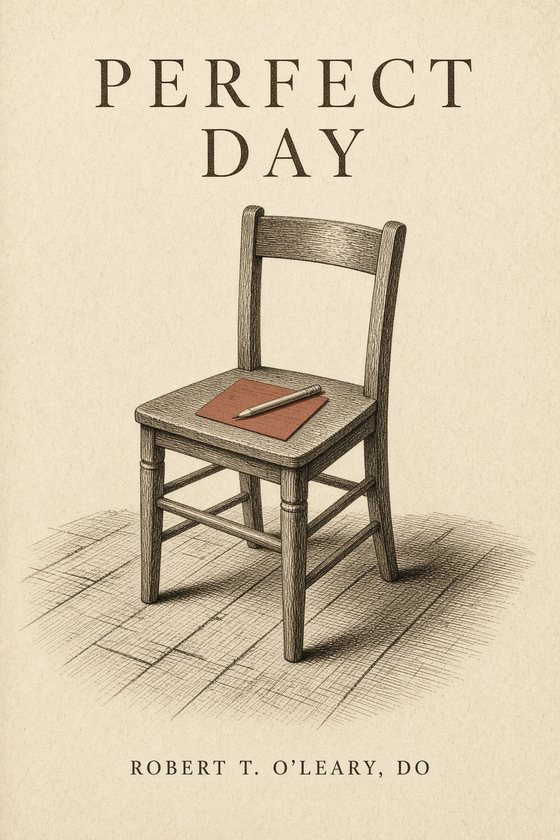
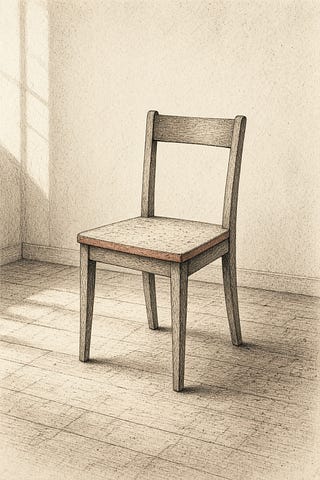
Cover of Perfect Day: a plain wooden chair on floorboards with an index card and pencil on the seat; pen and ink, the card in rust.

Perfect Day

Nonfiction
In progress

The practice book, one day hour by hour, for readers who want to know what to do tomorrow.

What would a day look like if every hour asked something?

Not a day without difficulty. A day in which every hour asked something, and was paid.

One day, hour by hour, shown twice: at thirty-five and at sixty-five, because the same act carries a different price on each side of a window that opens somewhere around forty-five. Every hour is offered at a floor, a standard and a ceiling; every load can be had from what you already own. One measurement, the chair stand, and one card, written the night before.

Read an excerpt

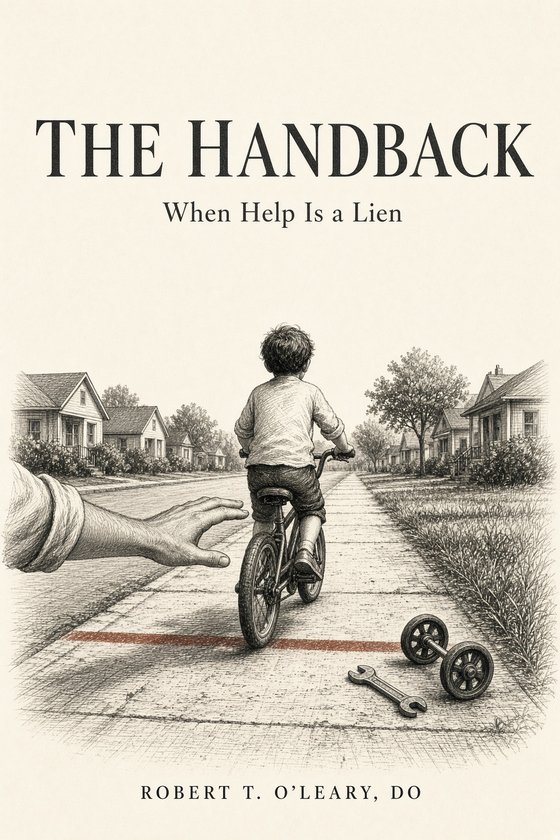
Cover of The Handback: a hand lets go as a child rides off on a bicycle, the training wheels and a wrench left on the sidewalk; pen and ink, a rust line across the path.

The Handback

When Help Is a Lien
Nonfiction
In progress

The book about help, for families, clinicians and the people who design it.

Is the help getting smaller, or are you?

What does any help leave for the person to do? And how would anyone know?

Every assistive thing changes what gets asked of a person: a cane, a brace, a hearing aid, a caregiver, a course of therapy that ends, a job that ends, a machine that drafts your work. While the help supplies part of the performance, the performance no longer says what the person alone can supply.

Read an excerpt

Publisher and agent inquiries for Don’t Solve for Comfort: [email protected]. Full manuscript available on request.

Measure your own reserve

The Functional Reserve Index is a free set of six simple self-tests: grip, two chair-stand tests, walking speed, balance, and an aerobic fitness estimate. Each result is measured against fixed published lines that do not move with age. Repeat the tests every few months, with any help written down, and the site shows whether your margin is holding. No account, and your results stay on your device.

Take the self-tests

reserve.theaskingpress.com · For education only, not medical advice.

The research

PublishedO’Leary RT. The Preservation of Functional Reserve: A Control Systems Framework for Human Aging. Life. 2026;16(9):1457. doi:10.3390/life16091457

O’Leary RT. Weaker, Not Just Lighter: Monitoring Strength and Function, Not Lean Mass, During GLP-1 Weight Loss. Preprints.org, 2026. Preprint. doi:10.20944/preprints202610.0108.v1

O’Leary RT. Assistance State as a Condition of Functional Measurement: Distinguishing Assisted Performance from Performance at a Lower Assistance State. Preprints.org, 2026. Preprint. doi:10.20944/preprints202609.2065.v2

O’Leary RT. The Reserve Protocol: A Measurement Specification for Functional Reserve. Preprints.org, 2026. Preprint. doi:10.20944/preprints202609.1685.v1

Every paper, preprint, protocol and code deposit · Full record at ORCID: 0009-0008-9552-358X

Essays

Short pieces from the clinic and the household, where the argument of the books meets a Tuesday. New essays post on Substack; subscribing is free.

The author

Robert T. O'Leary, D.O.

Robert T. O’Leary, D.O., is a physiatrist, double board-certified in physical medicine and rehabilitation and in pain medicine by the American Osteopathic Board of Physical Medicine and Rehabilitation. He has practiced for more than thirty-two years and is a clinical associate professor at the Orlando College of Osteopathic Medicine. He was named a Castle Connolly Top Doctor, 2014–2025. His work concerns functional reserve: the distance between what you can do and the fixed tasks of an independent life.

Contact

[email protected]